Background Color

From Explanation to Evaluation
A Mechanistic CT Scan for Your AI Models

Powered by interaction-based explanation theory, we penetrate black boxes to enable mechanistic-level evaluation and security reinforcement.

Why Do Your AI Models Need
Mechanistic-level Evalution?

Why Do Your AI Models Need
Mechanistic-level Evalution?

Output accuracy = Mechanistic reliability ?

The high accuracy of the model outputs does not imply reliable underlying mechanisms.

Experientially judged data quality = The real utility of data?

AI model scene

Mechanistic vs Traditional Evaluation

Exclusive Mechanistic Evaluation Solutions

The unique mechanistic audit to quantify safety and compliance while identifying and eliminating underlying risks.

Mechanistic vs Traditional Evaluation

Exclusive Mechanistic Evaluation Solutions

The unique mechanistic audit to quantify safety and compliance while identifying and eliminating underlying risks.

Mechanistic vs Traditional Evaluation

Exclusive Mechanistic Evaluation Solutions

The unique mechanistic audit to quantify safety and compliance while identifying and eliminating underlying risks.

Dimension

Evaluation Objectives

Capacity of Evaluating Generalizability

Fidelity

Security Reinforcement

AND-OR Interaction Mechanistic Evaluation

intrinsic mechanisms with clear semantics and verifiable numerical values

Disentangling non-generalizable interactions that cause the overfitting of a DNN

The faithfulness of interaction mechanisms can be mathmatically verified

Can efficiently improve the reliability of of interaction mechanisms

Traditional AI Evaluation

Only evaluates output results

Only evaluates output correctness

Cannot ensure the sparsity of neuron activations

Hard to directly identify and optimize problematic neurons

Dimension

Evaluation Objectives

Capacity of Evaluating Generalizability

Fidelity

Security Reinforcement

AND-OR Interaction Mechanism Evaluation

intrinsic mechanisms with clear semantics and verifiable numerical values

Disentangling non-generalizable interactions that cause the overfitting of a DNN

The faithfulness of interaction mechanisms can be mathmatically verified

Can efficiently improve the reliability of of interaction mechanisms

Traditional AI Evaluation

Only evaluates output results

Only evaluates output correctness

Cannot ensure the sparsity of neuron activations

Hard to directly identify and optimize problematic neurons

AND-OR Interaction Mechanistic Evaluation

Evaluation Objectives

intrinsic mechanisms with clear semantics and verifiable numerical values

Capacity of Evaluating Generalizability

Disentangling non-generalizable interactions that cause the overfitting of a DNN

Fidelity

The faithfulness of interaction mechanisms can be mathmatically verified

Security Reinforcement

Can efficiently improve the reliability of of interaction mechanisms

Traditional AI Evaluation

Evaluation Objectives

Only evaluates output results

Capacity of Evaluating Generalizability

Only evaluates output correctness

Fidelity

Cannot ensure the sparsity of neuron activations

Security Reinforcement

Hard to directly identify and optimize problematic neurons

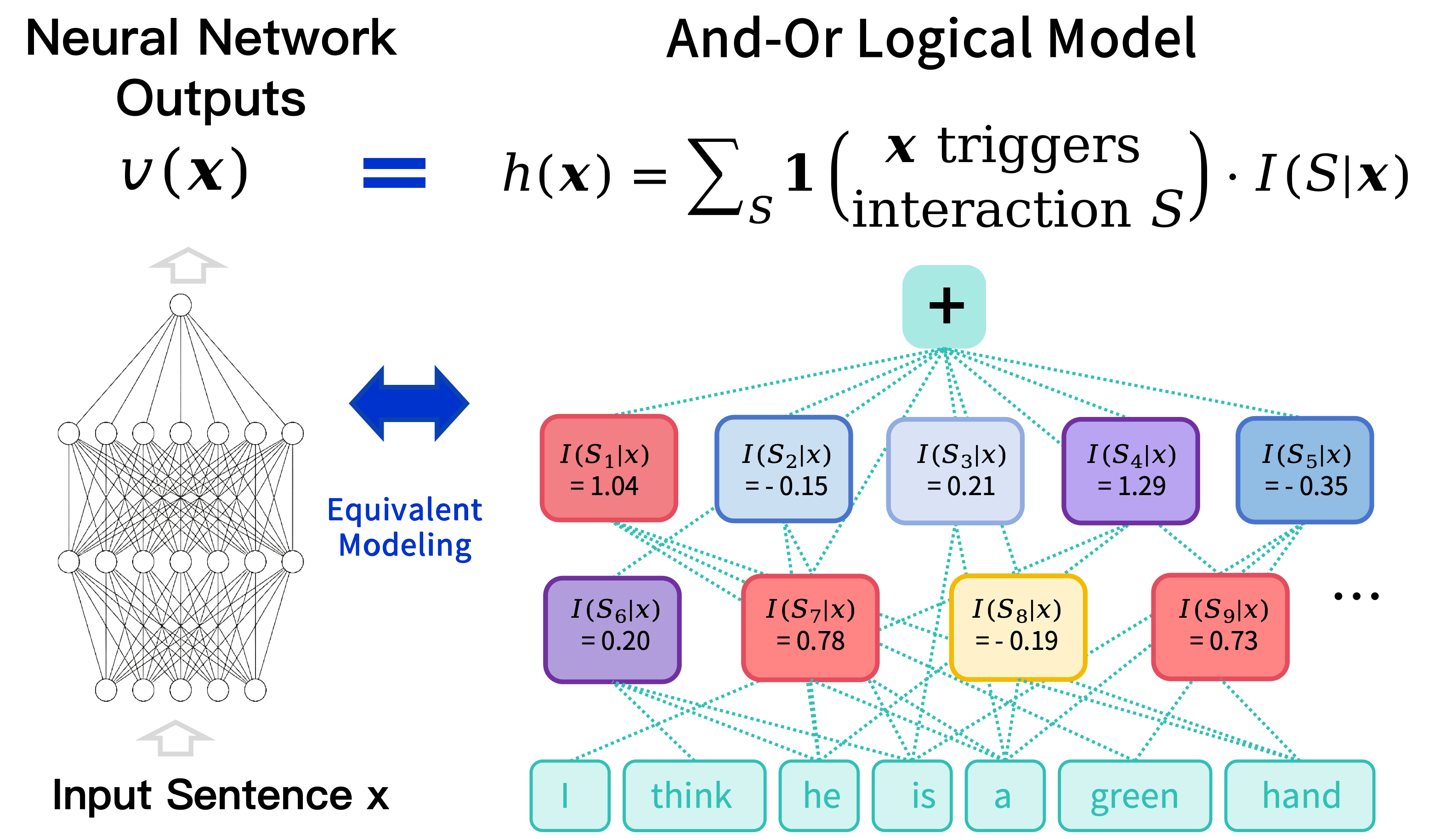
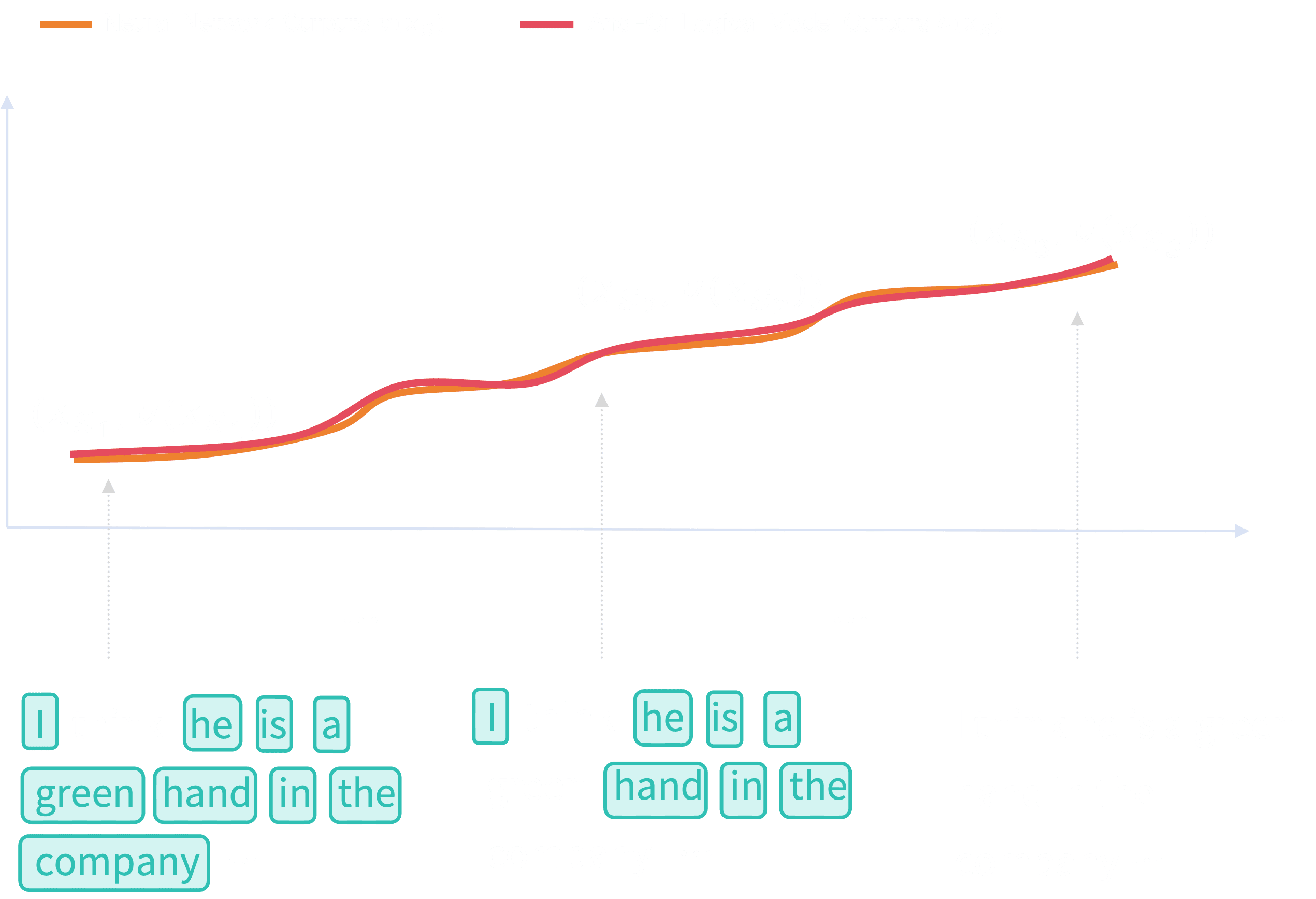
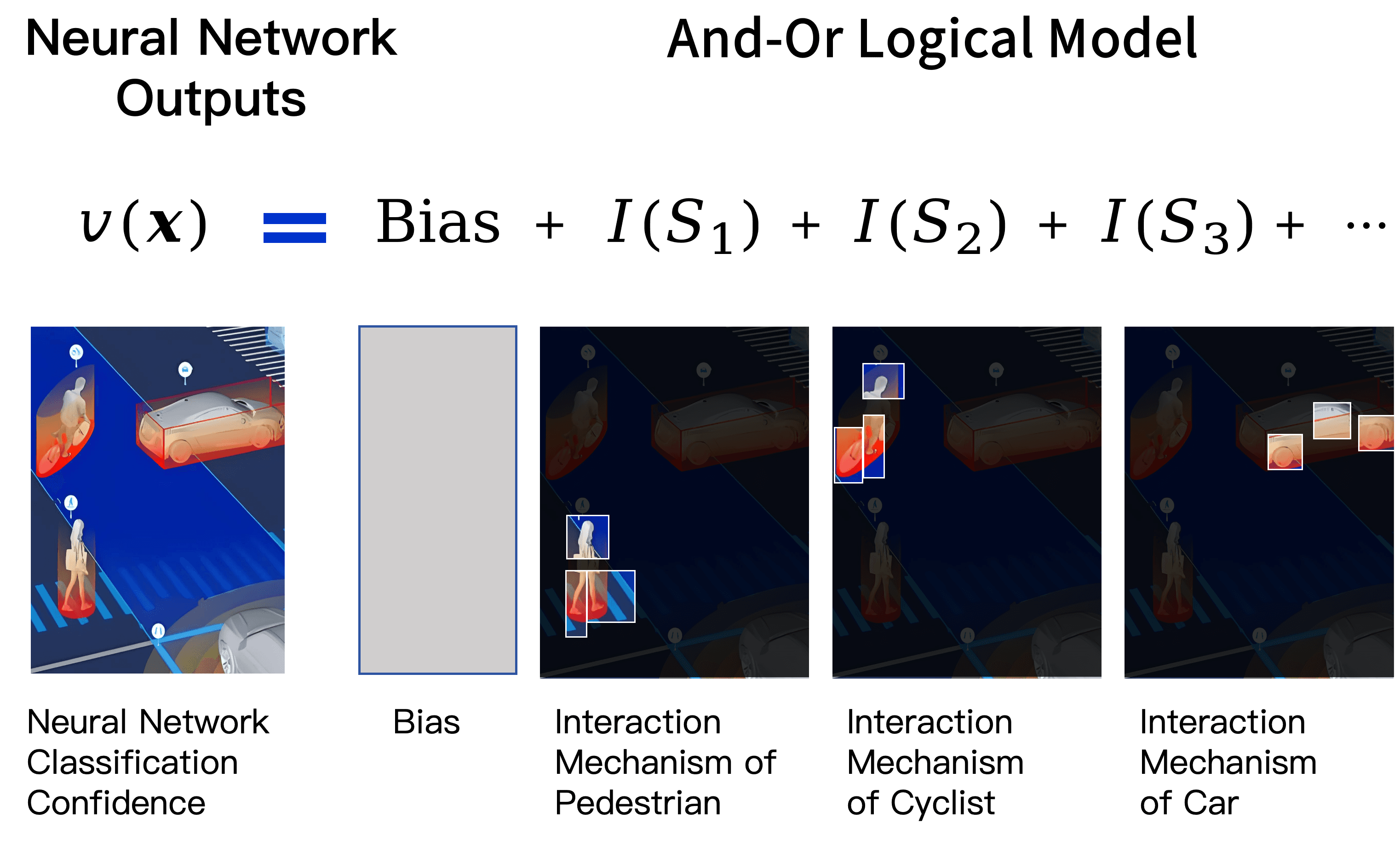
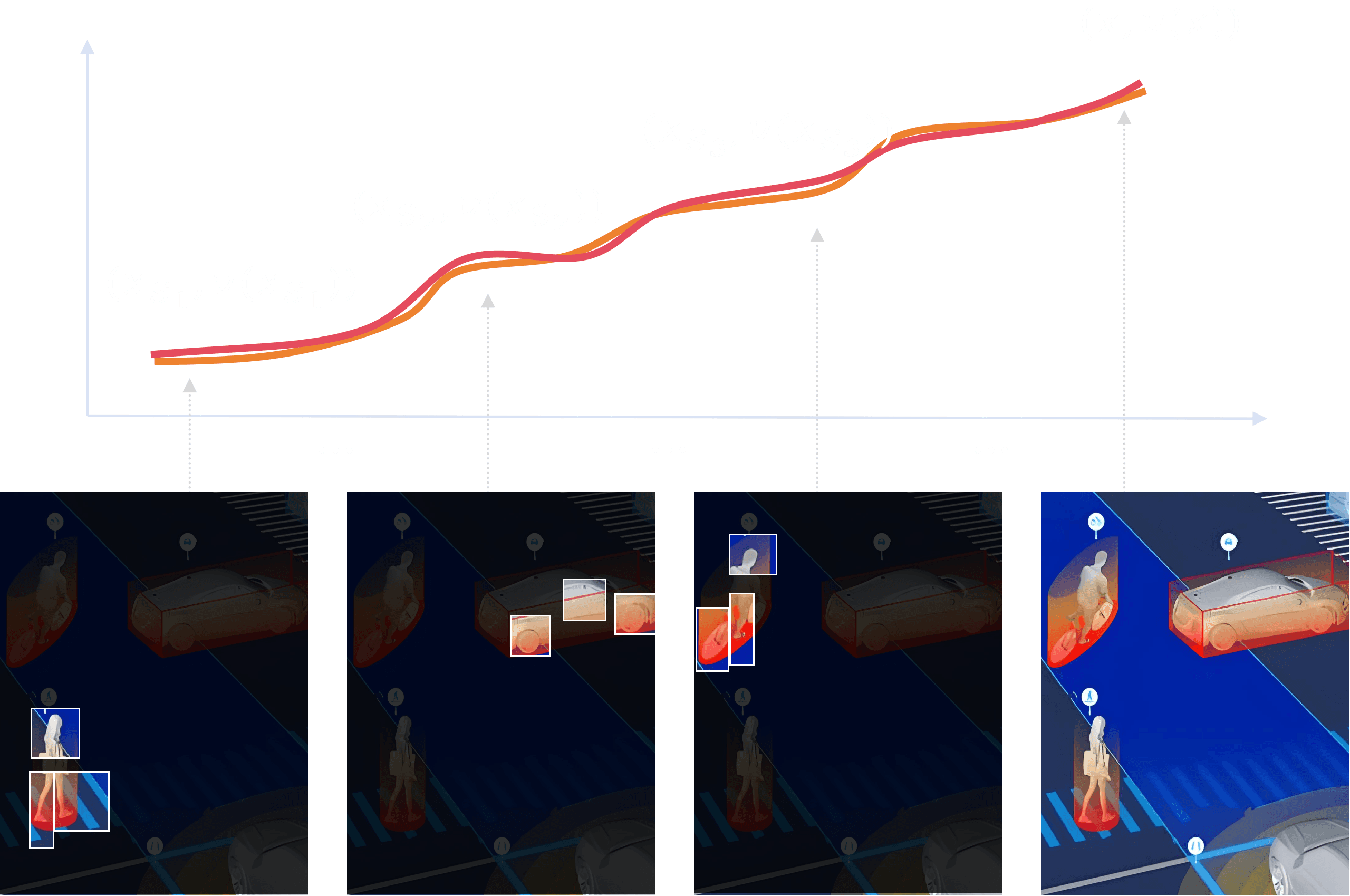
Universal Matching & Sparsity Property

Guaranteed Faithfulness

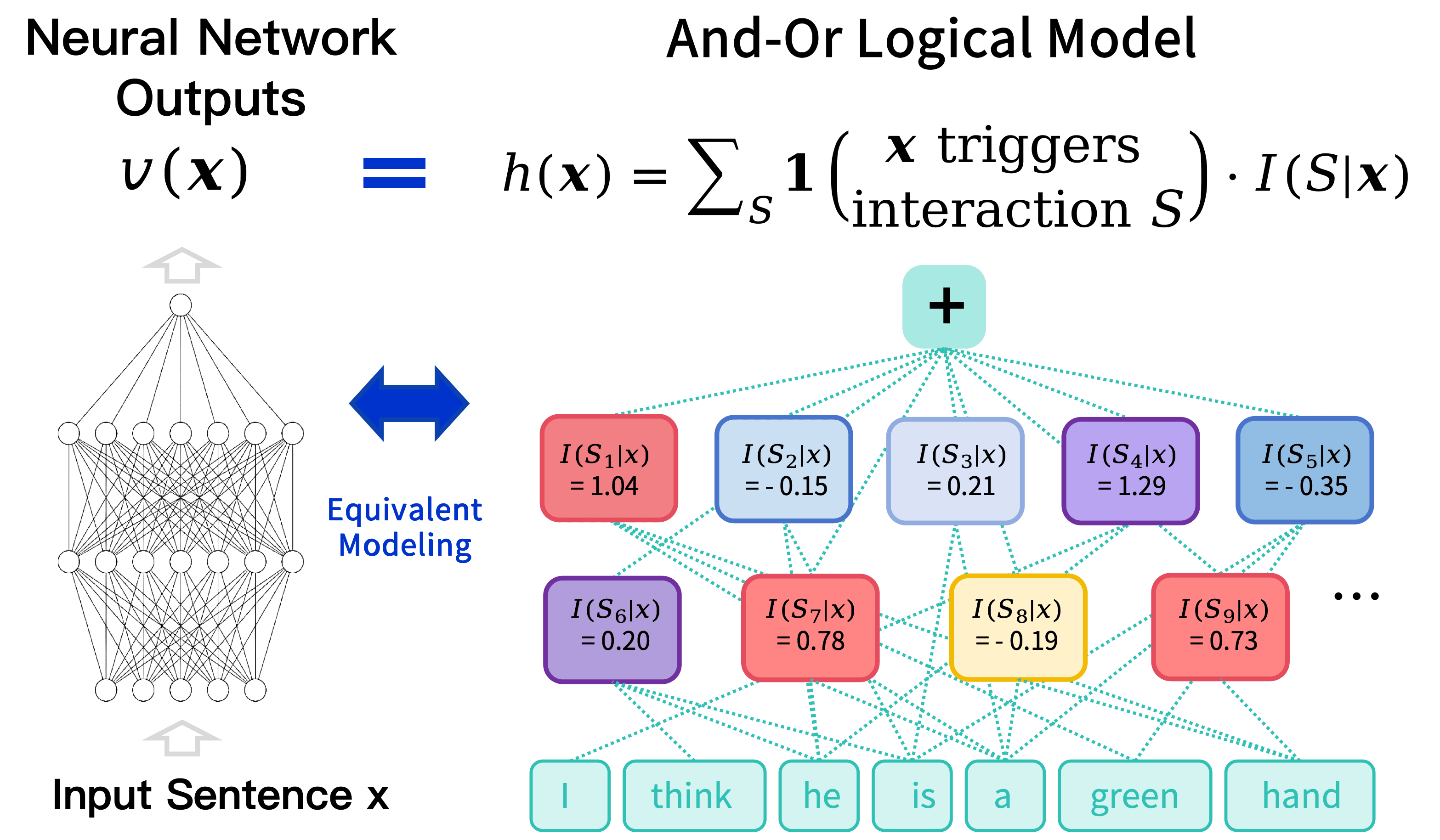
The trustworthiness of interaction mechanisms is ensured by both the universal matching property and the sparsity property. This means that regardless of random masking applied to input variables, sparse interaction mechanisms can always accurately align with the output scores of a DNN.

Universal Matching & Sparsity Property

Guaranteed Faithfulness

The trustworthiness of interaction mechanisms is ensured by both the universal matching property and the sparsity property. This means that regardless of random masking applied to input variables, sparse interaction mechanisms can always accurately align with the output scores of a DNN.

Universal Matching & Sparsity Property

Guaranteed Faithfulness

The trustworthiness of interaction mechanisms is ensured by both the universal matching property and the sparsity property. This means that regardless of random masking applied to input variables, sparse interaction mechanisms can always accurately align with the output scores of a DNN.

  • Scenario: Explaining Natural Language Processing

    Scenario: Explaining Natural Language Processing

    Rigorously mimics a neural network's outputs across all 2^n masked samples.

    Scenario: Explaining Natural Language Processing
  • Scenario: Explaining Image Classification

    Scenario: Explaining Image Classification

    Rigorously mimics a neural network's outputs across all 2^n masked samples.

    Scenario: Explaining Image Classification
  • Scenario: Explaining Natural Language Processing
    Scenario: Explaining Natural Language Processing

    Rigorously mimics a neural network's outputs across all 2^n masked samples.

    Scenario: Explaining Natural Language Processing
  • Scenario: Explaining Image Classification
    Scenario: Explaining Image Classification

    Rigorously mimics a neural network's outputs across all 2^n masked samples.

    Scenario: Explaining Image Classification

AND-OR Interaction Mechanistic Evaluation

Mechanistic Evaluation for Reliable AI

Decomposign complex decision-making logic underlying billions of parameters into 50 to 150 interaction mechanisms, revealing potential risky representations.
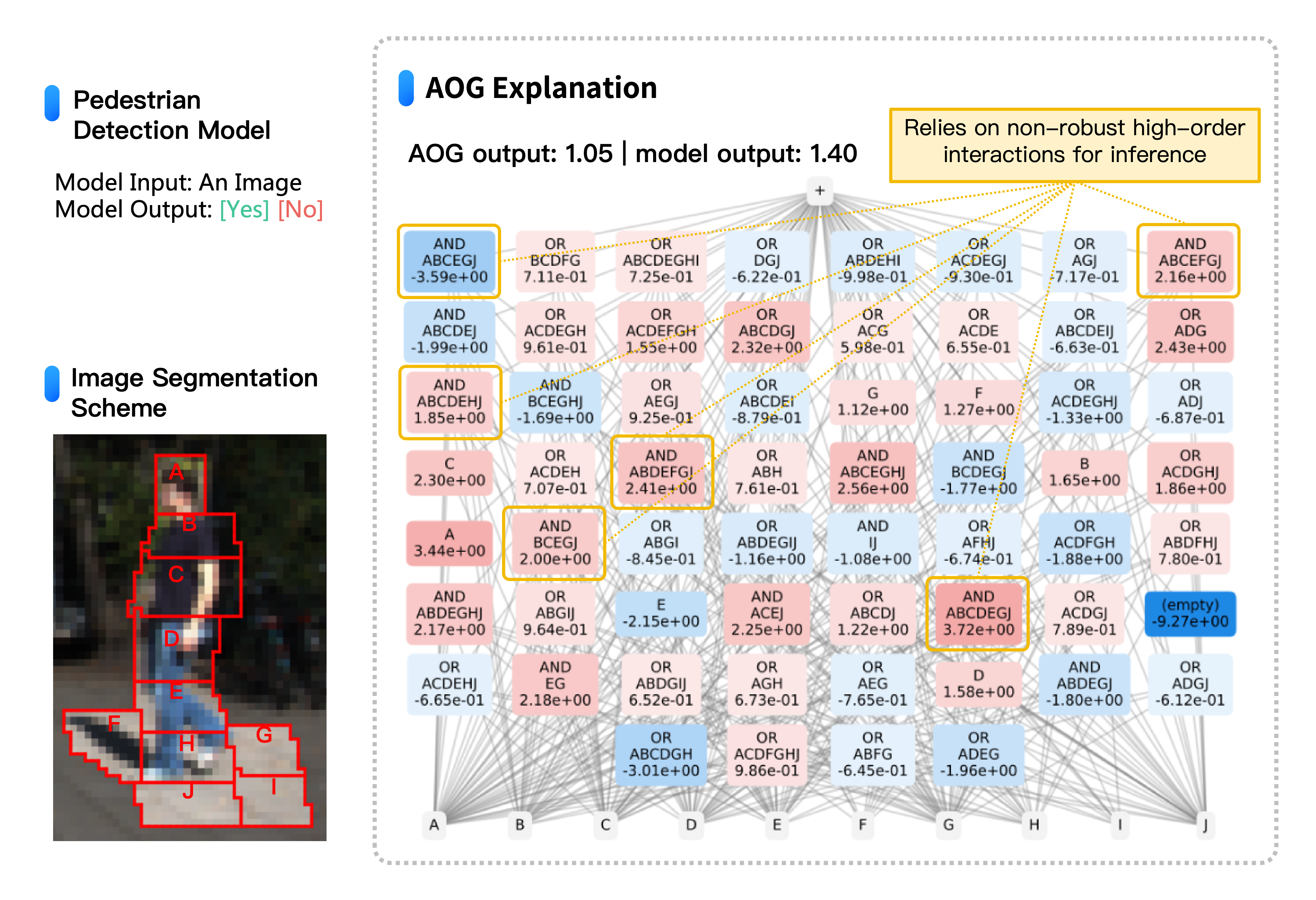
Autonomous Driving Object Detection: Mechanism Risk Evaluation
Representation Risk Evaluation for Autonomous Driving Models

In pedestrian detection, we found that despite correct outputs, over 60% of interactions risk "cancellation effects," over 60% interactions represented overfitted patterns.

Legal LLM Judgment: Mechanism Evaluation
Mechanistic Evaluation of Legal LLM Judgments

While judgments were correct, the logic relied on spurious correlations, many interaction mechanisms employed by the LLM indicated spurious correlations.

Innovation

Mechanistic Evaluation & Safety Enhancement

Based on our interaction-based explanation theory, we build a trusted closed loop across the full pipeline—from evaluation to reinforcement.

Based on our interaction-based explanation theory, we build a trusted closed loop across the full pipeline—from evaluation to reinforcement.

icon
Risk-Averse Applications

Detect hidden failure modes in safety-critical systems,even when outputs look correct.

High-Trust Decisions

Verify internal reasoning for decision-critical domains like finance and law.

Model Compression

Quantify and prevent mechanism distortion during compression for reliable edge deployment.

Don't let your model go live with hidden flaws.
Get a Mechanistic Report now.

Don't let your model go live with hidden flaws.
Get a Mechanistic Report now.

Identify deep-seated risk representations

Enhance model optimization efficiency

Pinpoint data causing model overfitting

AI model mechanism evaluation scene
Company Logo
Company Logo

Demystifying AI, Defining Trust.

Official WeChat

Contact

Business: contact@symtrustai.com

Product: product@symtrustai.com

Support: support@symtrustai.com

Address: Room 3309, Building 3, NeoBay, No. 951 Jianchuan Rd, Minhang District, Shanghai

©SymtrustAI Co., Ltd. 2026 All Rights Reserved

ICP No. 2026002871-1

Public Security No. 31011202022067

Company Logo
Company Logo

Demystifying AI, Defining Trust.

Official WeChat

Contact

Business: contact@symtrustai.com

Product: product@symtrustai.com

Support: support@symtrustai.com

Address: Room 3309, Building 3, NeoBay, No. 951 Jianchuan Rd, Minhang District, Shanghai

©SymtrustAI Co., Ltd. 2026 All Rights Reserved

ICP No. 2026002871-1

Public Security No. 31011202022067

Company Logo
Company Logo

Demystifying AI, Defining Trust.

Official WeChat

Contact

Business: contact@symtrustai.com

Product: product@symtrustai.com

Support: support@symtrustai.com

Address: Room 3309, Building 3, NeoBay, No. 951 Jianchuan Rd, Minhang District, Shanghai

©SymtrustAI Co., Ltd. 2026 All Rights Reserved

ICP No. 2026002871-1

Public Security No. 31011202022067