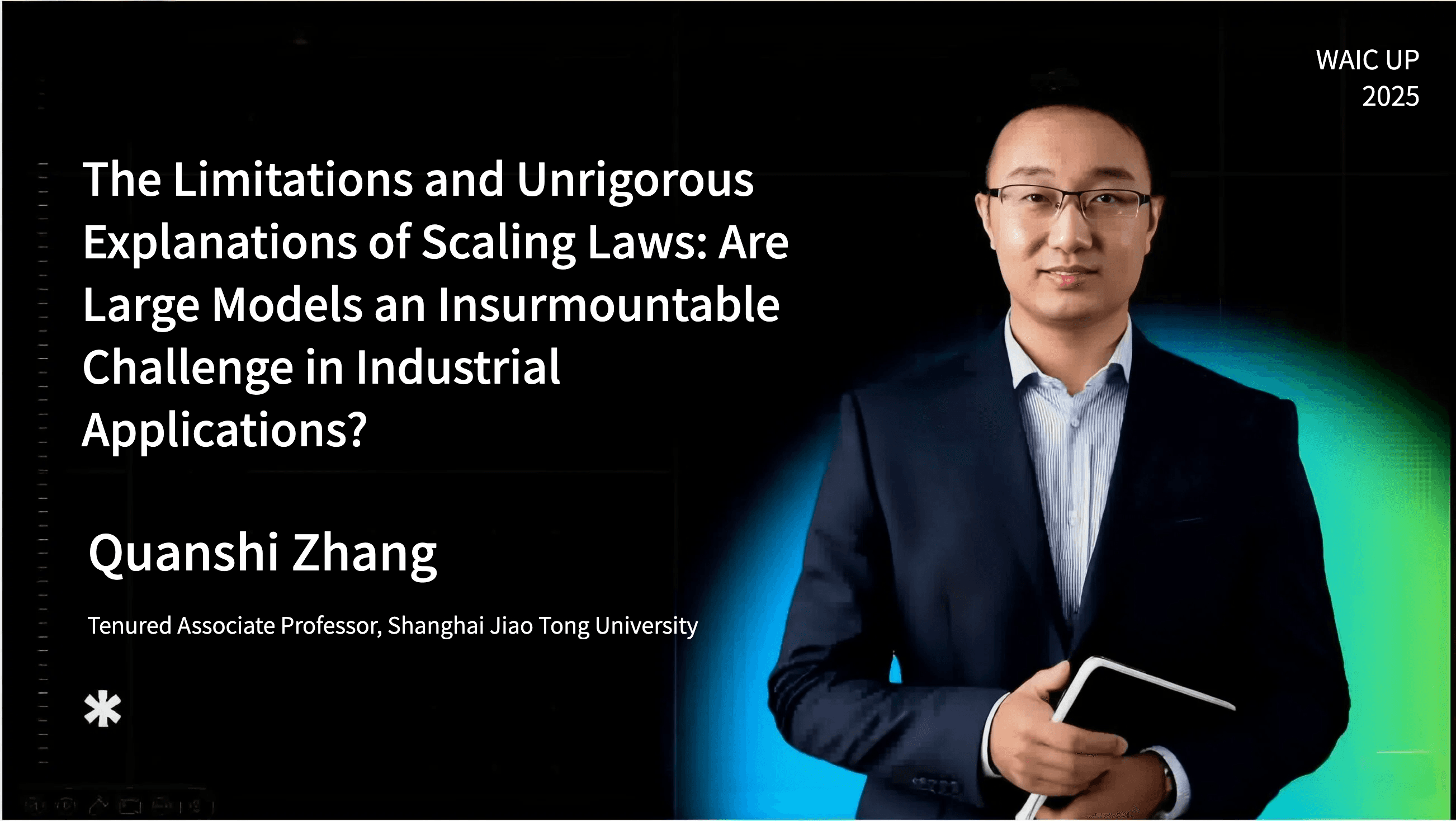
At the 2025 World Artificial Intelligence Conference (WAIC), the company's founder, Professor Quan-Shi Zhang from Shanghai Jiao Tong University, was invited to deliver a keynote speech titled "The Limitations and Unrigorous Explanations of Scaling Laws: Are Large Models an Insurmountable Challenge in Industrial Applications?", systematically presenting major theoretical breakthroughs and industrial practices in the field of rigorous interpretability of large models.
Addressing Industry Pain Points: "Three Dilemmas" Beyond the Scaling Law
Professor Quan-Shi Zhang pointed out that the current AI field faces three core dilemmas:
⭕️ Evaluation Dilemma: Existing evaluations focus only on output results without diagnosing model errors mechanism-wise, leading to ranking phenomena and failing to answer "where the error is, how to improve";
⭕️ Training Dilemma: Model optimization relies on trial and error; developers only know about performance gaps but not whether it is due to insufficient data, poor data quality, or incorrect algorithm choice. The gap between OpenAI and DeepSeek cannot be quantitatively analyzed;
⭕️ Deployment Dilemma: Lacks hard metrics that can apply universally, akin to selling models like smartphones rather than graphics cards, hindering the objective demonstration of technological superiority.
The root of these dilemmas lies in the lack of interpretability. Zhang emphasized that if we can only penalize models based on results and not discover issues or guide optimizations at an internal logic level, AI's industrial applications will remain in a black-box trial-and-error phase.
Theoretical Breakthrough: Sparse Logical Deconstruction of Complex Neural Networks
To tackle this world-class problem, the company's team proposed a rigorous interpretative modeling framework, mathematically proving for the first time: Under the premise of satisfying three mathematical properties, the complex decision logic of large models could be rigorously interpreted as sparse symbolic logic graph models. Specifically, this technology can:
Extract AND-OR Logic: Deconstruct neural network decision processes into 50-150 AND-OR interactions, quantifying the interaction relationships between input units;
Achieve Rigorous Fitting: Precisely fit a neural network's output across an exponential input space (2^N states) using extremely sparse logical relations (only about 100 interaction terms), achieving the mathematical rigor of 1+1=2 rather than approximate fitting;
Cross-Model Versatility: Applicable to various neural network architectures such as large language models, image classification models, and generative models.
This implies that we can use simple symbolic logic to comprehensively fit the behavior of complex neural networks. Zhang explained, like a CT scan on the brain, we can now accurately diagnose the knowledge structures of AI models.
Practical Validation: From Error Diagnosis to Performance Leap
In the presentation, Zhang demonstrated the application results of this technology in industrial-grade scenarios:
⭐️ Legal Large Model Risk Diagnosis: In a legal decision model, the technology revealed that the model wrongly attributed the fact of Wang Wu's murder to Zhang San's decision logic, with over two-thirds of internal interactions being misattributed, a systematic error undetectable by traditional evaluations.
⭐️ Visual Model Representation Analysis: In advanced image detection models, found that more than 90% of regional interaction information presented positive-negative offsets (half the logic deems "yes," while the other half "no"), typical of overfitting and misrepresentation, explaining why traditional models lack robustness in specific scenarios.
⭐️ Revolutionary Training Efficiency Enhancement: By distinguishing "generalizable interactions" from "non-generalizable interactions" (i.e., correct knowledge points and erroneous memories), the company achieved precise evaluation of the model's knowledge structures. Research found a 70% high overlap at the knowledge point level between different architectures and datasets trained large models, Qwen and DeepSeek, confirming the primacy of knowledge. Based on this, training is no longer a blind punitive process, but can be strategically optimized, with algorithm efficiency improvements reaching 10-100 times.
Comprehensive Leadership: Redefining Industrial Standards for Large Models
Zhang stated that the company's interpretability technology in dimensions such as rigor, performance validation, and engineering implementation has comprehensively surpassed existing solutions from giants like Google and OpenAI:
✅ Risk-Sensitive Scenarios: Provides debugeable safety assurance for high-risk applications such as autonomous driving, financial risk control, legal verdicts, and national defense;
✅ Scientific Research Enablement: Helps researchers validate whether black-box models have truly learned objective scientific rules rather than noise fitting;
✅ Training Paradigm Innovation: Achieves exam-style training with real-time monitoring of model knowledge mastery, completely freeing capacity and data scaling law traps.
The future of AI industrialization should not be a trial-and-error game dependent on sheer brute force. Zhang concluded, through rigorous interpretability technology, we transition large models from being emotional black boxes to hard-core tech products akin to graphics cards. This is a leap from knowing the "what" to understanding the "why," a necessary path for AI to achieve reliable industrial applications.
Currently, the company has established deep collaborations with multiple clients in risk-sensitive industries, committed to transforming this foundational technical capability into standardized solutions, driving the AI industry into a new era of interpretable, evaluable, and optimizable advancements.